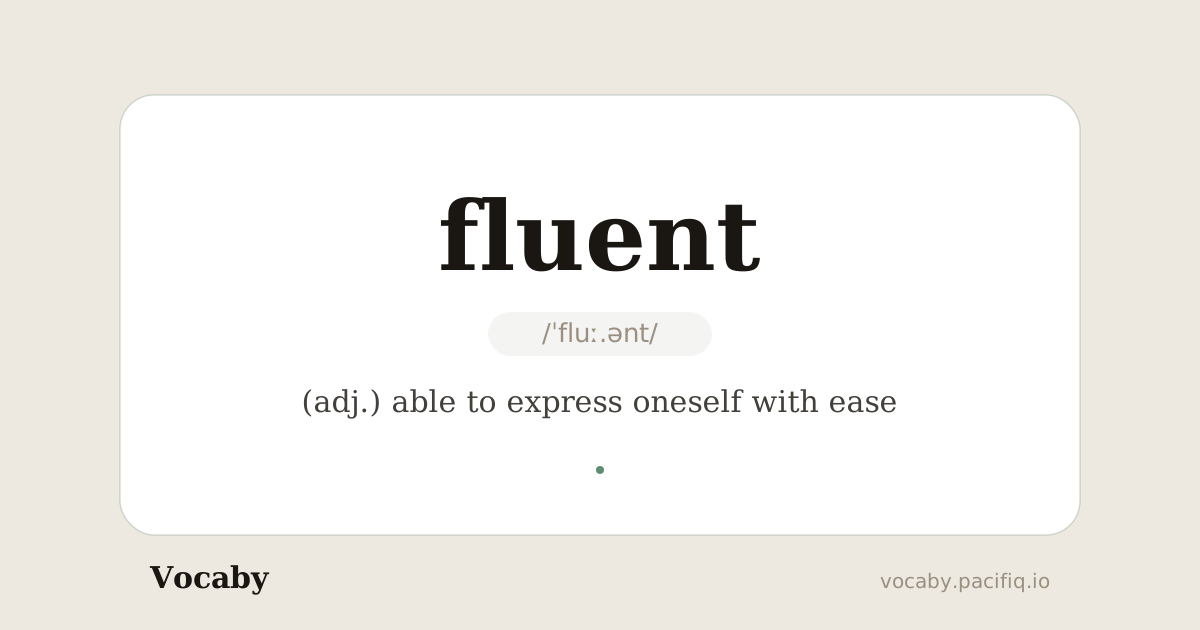
The most reliable way to build English vocabulary as a Korean speaker is to stop memorizing bare 단어장 pairs and start learning each word in context, with its sound. Meet the word in an example sentence, hear its pronunciation, watch for Konglish false friends, and review on a spaced schedule so it actually stays.
That is the short version. The longer answer matters, because the way most of us first studied English in Korea works against long-term memory. Endless columns of word-equals-meaning, highlighter everywhere, the same 단어장 reviewed the night before a test and forgotten the week after. This guide on English vocabulary for Korean speakers walks through what actually works, why it works, and how to fit it into a daily habit you can keep.
Why does rote 단어장 memorization fail Korean learners?
Almost every Korean learner has done it: a vocabulary book, a Korean gloss in the next column, and a quiet promise to memorize fifty words tonight. It feels productive. The problem is what you are actually storing.
When you memorize apprehensive = 불안한 as a flat pair, you give your brain one thin thread to the word and nothing else. There is no sentence, no sound, no situation where you would say it. So when the test is over, the thread snaps. You have probably felt this: you “know” you studied a word, but in a real conversation it simply will not come.
Rote pairs fail for three reasons:
- No context. You learn a label, not how the word behaves.
불안한does not tell you that apprehensive is usually about what is coming next, not general anxiety. - No sound. A word you have only read, never heard, is a word you cannot recognize when a native speaker says it quickly.
- No use. You can pick the right answer on a multiple-choice test and still freeze when you need to produce the word yourself.
None of this means vocabulary lists are useless. The fix is not to throw them away; it is to attach context, sound, and use to every word you keep.
How should Korean speakers learn English words in context?
A Korean translation is a starting point, not the finish line. Knowing that candid roughly means 솔직한 tells you almost nothing about how the word feels or which words it likes to sit next to (a candid conversation, a candid photo, brutally candid).
Context teaches the things a 단어장 column skips:
- Connotation. Thrifty and stingy both land near
절약하는, but one is a compliment and the other an insult. A flat gloss hides that. - Collocation. English fixes certain partners. You make a decision and take a risk; swapping them sounds off even when each word is “correct.”
- Register. Purchase and buy mean the same thing in very different rooms. Context tells you which room you are in.
The practical move: never save a word alone. Save it with the sentence you met it in, so the meaning, the grammar, and the natural partners all travel together. This is also the single biggest upgrade over the way most of us studied for the 수능 or TOEIC, where the word and its one gloss were the whole story.
Why does pronunciation matter so much for Korean learners?
Korean and English have genuinely different sound systems, so pronunciation is not a finishing touch you add later. It changes whether you can use a word at all. A word you cannot say is a word you avoid; a word you have never heard is one you will miss when someone says it at natural speed.
A few sound distinctions trip up Korean speakers in particular:
- r and l — right and light, collect and correct. Korean has one liquid sound that sits between them, so the two need deliberate practice to separate.
- f and p — coffee often drifts toward
커피, file toward pile. The f sound has no close Korean match. - b and v — base and vase, berry and very.
- Final consonants and syllables — English desk is one syllable, but it is tempting to add a vowel and say it like
데스크, three beats. Hearing the real shape fixes this.
Three habits close the gap:
- Learn the sound with the meaning, from the very first exposure, instead of guessing from spelling and unlearning later.
- Use IPA as a map. The phonetic spelling shows exactly which sounds and which stressed syllable a word carries, which is gold for words that do not look the way they sound (colonel, subtle, comfortable).
- Listen, then say it out loud. Hearing native audio and repeating it builds the link between recognizing a word and producing it.
This is why every word in Vocaby carries IPA and audio, not just a definition. You learn how a word sounds at the same moment you learn what it means.
What Konglish and false friends should Korean learners watch for?
Some English-looking words feel completely safe to a Korean speaker, which is exactly what makes them dangerous. Konglish words and false friends look and sound like English, so we assume they transfer. They do not, and a native speaker will be politely confused.
Here are a few accurate examples worth knowing:
| Konglish / false friend | What Korean speakers often mean | Correct English usage |
|---|---|---|
| fighting (화이팅) | “You can do it!” / “Good luck!” | Native speakers say Good luck!, You’ve got this!, or Go for it! In English, fighting just means physically fighting. |
| hand phone (핸드폰) | a mobile phone | Say cell phone (US) or mobile phone (UK). Hand phone is not used by native speakers. |
| service (서비스) | something given for free, “on the house” | Say it’s on the house, a freebie, or complimentary. In English, service means assistance or how you are treated, not a free item. |
| meeting (미팅) | a casual blind date / group date | In English, a meeting is a work or business gathering. For the dating sense, say a blind date or a set-up. |
| one-piece (원피스) | a dress | The everyday word is dress. One-piece in English usually means a one-piece swimsuit. |
| skinship (스킨십) | affectionate physical touch | There is no single English word; say physical affection or being touchy-feely. |
The lesson is not to fear these words but to learn their accurate English replacements deliberately, the same way you would any other vocabulary. Because they sound confident, the mistakes they cause are confident too, which is exactly why they are worth a dedicated pass.
How does spaced repetition help you remember English words?
You can meet a word ten times and still forget it if the timing is wrong. This is the real reason the night-before-the-test 단어장 cram never lasted: everything reviewed at once, then nothing, so the memory faded on schedule.
Spaced repetition fixes the timing. Instead of reviewing every word equally, it stretches the gap between reviews as a word sticks, bringing each one back right before you would forget it. This works because of the spacing effect: a memory strengthens most when you retrieve it at the edge of forgetting, not when it is still fresh.
In practice this means you stop wasting time on words you already own and spend it on the handful that genuinely need another look. A word you nail gets pushed weeks into the future; one you fumble comes back tomorrow. Modern apps automate this with algorithms like FSRS. In Vocaby you rate each word Again, Hard, Good, or Easy, and it schedules the next review for you, so ten minutes a day does the work of a much longer session. If you want the underlying science, we go deeper in our guide to spaced repetition.
How do you build a daily English vocabulary habit?
The strongest predictor of vocabulary growth is not talent or a perfect TOEIC score. It is showing up. A learner who does ten honest minutes a day will pass one who attempts a heroic three-hour session once a month and then burns out.
To make the habit automatic:
- Keep it small. Ten to fifteen minutes is plenty. A goal you can hit on a tired, busy day is a goal you keep.
- Anchor it to a routine you already have. Review during your commute, or with your morning coffee. Attach the new habit to something you already do without thinking.
- Let the words come to you. A word of the day and a home-screen widget mean you bump into new vocabulary without deciding to, which removes the hardest step: starting.
- Track your streak. A visible streak quietly turns “I should study” into “I don’t want to break the chain.”
Consistency beats intensity every time. If you want a fuller playbook, our guide on how to build vocabulary fast lays out nine methods that fit into the same light routine.
How does Vocaby fit a Korean learner’s routine?
Everything above folds into one app instead of a scattered stack of tools. Vocaby was built so the daily ten minutes do all the work for you:
- 29,000+ English words, each with IPA, native audio, a clear definition, example sentences, and synonyms, so you learn meaning, sound, and context together rather than as a bare pair.
- FSRS spaced repetition that schedules each review for the moment just before you would forget, so nothing you learn quietly slips away.
- A swipe-to-learn flow and curated decks (Business, travel, exam prep, and more) so you can aim your effort at the words you actually need.
- Word of the day plus a home-screen widget, and add-any-word auto-fill so a word you hear in a movie or meeting becomes a card in seconds.
- A growing Korean word set, so Korean speakers strengthening their own first-language vocabulary, or anyone learning Korean, has a home here too.
- A warm, paper-like design that makes studying feel calm instead of like cramming for an exam.
You can browse pronunciations and example sentences anytime in the open word library before you commit a word to memory.
Building English vocabulary as a Korean speaker is not about a secret hack or a thicker 단어장. It is about learning words in context, with their sound, and reviewing them at the right time, every day. Start with ten minutes today and let the habit do the rest.
Download Vocaby on the App StoreFrequently asked questions
- Why do Korean learners forget English words so quickly?
- Usually because the words were memorized as bare Korean-English pairs, with no context, sound, or use attached. A word stored as one isolated definition has almost nothing to hook onto in memory. When you learn the same word inside an example sentence, hear how it sounds, and review it on a spaced schedule, you give your brain several different paths back to it, and it sticks far longer.
- Is it better to memorize a 단어장 or learn words in context?
- Context wins for real use. A 단어장 column of word equals meaning is fast to drill but teaches you only a label you can recite, not a word you can actually deploy. Example sentences show the word's tone, its grammar, and the words it naturally pairs with, which is exactly what you need to speak and write without sounding translated.
- How do I fix the gap between Korean and English pronunciation?
- Learn the sound at the same moment you learn the meaning, instead of guessing from spelling and unlearning later. Use IPA as a map for tricky words, listen to native audio, and say each word out loud. Because Korean and English have different sound systems, separating sounds like the English r and l, or f and p, takes deliberate listening practice rather than reading alone.
- What is Konglish and why does it cause mistakes?
- Konglish refers to English-looking words and phrases that are used in Korean with a different meaning than native English, such as cheering someone on with fighting or calling a mobile phone a hand phone. They feel like English, so learners assume they transfer, but native speakers will not understand them. Knowing the accurate English equivalent for these false friends prevents confident-sounding mistakes.
Keep reading
Anki vs Vocaby: Which Is Better for Building Vocabulary?
A fair, head-to-head look at Anki vs Vocaby for building English vocabulary. Anki gives you total flexibility and your own cards; Vocaby gives you 29,000+ ready words with pronunciation, examples, and spaced repetition built in. Here is how to choose.
30 Beautiful English Words and What They Mean
A curated collection of the most beautiful English words, complete with accurate IPA pronunciation, definitions, and graceful example sentences. Discover words about feelings, nature, and the quiet passage of time.
The Best Vocabulary Apps in 2026: An Honest Comparison
A fair, balanced look at the best vocabulary apps in 2026, including Vocaby, Anki, Quizlet, Magoosh, WordUp, and Memrise. We compare spaced repetition, pronunciation, free tiers, and who each app actually suits.