If you are short on time, here is the direct answer: study SAT vocabulary in small daily batches using spaced repetition, and always learn each word inside an example sentence rather than as a bare definition. The Digital SAT tests words in context, so seeing how a word behaves in a real sentence is what actually helps you pick the correct answer on test day.
That single shift, from memorizing definitions to learning words in context, is the most important thing this guide will teach you. Below you will find 40 high-frequency SAT vocabulary words with concise meanings and example sentences, plus a clear study method that uses both spaced repetition and context.
How the Digital SAT actually tests vocabulary
The Digital SAT does not ask you to recite definitions. Instead, the Reading and Writing section includes a question type called Words in Context. You read a short passage, and one word is either blank or underlined. Your job is to choose the word that best fits the meaning, tone, and logic of the sentence.
Here is why that distinction matters. A question might offer four words that all share a rough meaning, and only one fits the precise shade the sentence needs. If you only memorized that “candor” means “honesty,” you might still miss a question that hinges on candor implying frank, unguarded honesty rather than mere truthfulness. The example sentence is where that nuance lives.
So the goal is not to collect a giant pile of rare words. The goal is to deeply know a focused set of high-frequency academic words, including how each one feels in a sentence. The list below is built for exactly that.
The 40 high-frequency SAT vocabulary words
Use this table as your core study set. Read each example sentence aloud once. The sentence does more work than the definition.
| Word | Part of speech | Definition | Example sentence |
|---|---|---|---|
| ambiguous | adjective | open to more than one interpretation; unclear | The poem’s ending is deliberately ambiguous, leaving readers to decide what happens. |
| candor | noun | honesty and directness in speech | She answered the difficult question with surprising candor. |
| pragmatic | adjective | dealing with things practically rather than ideally | His pragmatic approach focused on what could actually be built this year. |
| ephemeral | adjective | lasting for a very short time | The beauty of cherry blossoms is ephemeral, fading within a week. |
| scrutinize | verb | to examine closely and critically | The auditor scrutinized every line of the budget. |
| advocate | verb | to publicly support or argue for | Many scientists advocate for stronger limits on emissions. |
| undermine | verb | to weaken or damage gradually | Constant criticism can undermine a student’s confidence. |
| nuance | noun | a subtle difference in meaning or tone | A good translator captures the nuance of the original text. |
| benevolent | adjective | kind and well-meaning | The benevolent donor funded scholarships for low-income students. |
| arbitrary | adjective | based on personal whim rather than reason | The rule seemed arbitrary, with no clear purpose behind it. |
| coherent | adjective | logical and well-organized; easy to follow | Her essay presented a coherent argument from start to finish. |
| diligent | adjective | showing careful and persistent effort | A diligent researcher checks every source twice. |
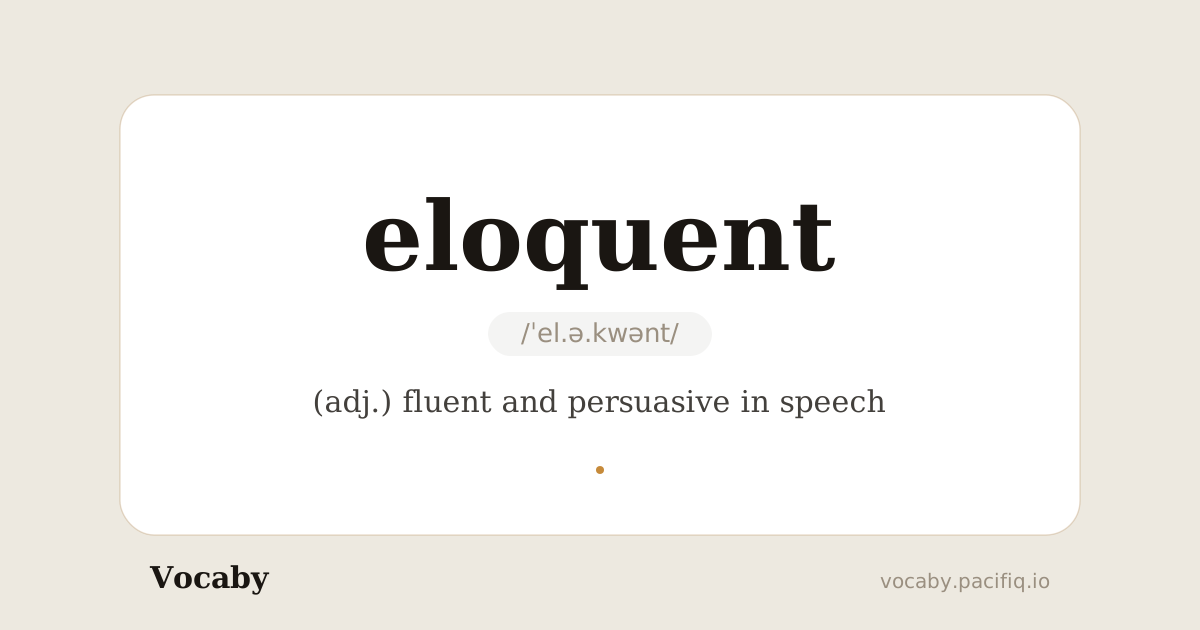
| eloquent | adjective | fluent and persuasive in speech or writing | The senator gave an eloquent speech that moved the crowd. |
| feasible | adjective | possible to do easily or conveniently | The committee asked whether the plan was financially feasible. |
| inevitable | adjective | certain to happen; unavoidable | As prices rose, the protests felt inevitable. |
| meticulous | adjective | showing great attention to detail | The watchmaker was meticulous about every tiny gear. |
| novel | adjective | new and original | The team proposed a novel solution no one had tried before. |
| obscure | adjective | not well known; hard to understand | He cited an obscure law that few attorneys had ever read. |
| plausible | adjective | seeming reasonable or probable | The detective considered every plausible explanation. |
| prudent | adjective | acting with care and good judgment | It is prudent to save money before making a large purchase. |
| skeptical | adjective | not easily convinced; doubtful | Investors were skeptical of the company’s bold promises. |
| superficial | adjective | concerned only with the surface; shallow | His knowledge of the topic was superficial at best. |
| tenacious | adjective | holding firmly; persistent | Her tenacious effort eventually paid off. |
| viable | adjective | capable of working successfully | The startup needed a viable business model to attract funding. |
| candidate | noun | a person who applies for or is suited to something | Each candidate answered the panel’s questions in turn. |
| concise | adjective | giving information clearly in few words | The instructions were concise and easy to follow. |
| consensus | noun | general agreement among a group | The team reached a consensus after a long discussion. |
| deter | verb | to discourage someone from acting | High fines are meant to deter reckless driving. |
| diminish | verb | to make or become smaller or less | Funding cuts diminished the program’s reach. |
| empirical | adjective | based on observation or experiment | The claim lacked empirical evidence to support it. |
| facilitate | verb | to make an action or process easier | A clear agenda can facilitate a productive meeting. |
| inherent | adjective | existing as a natural, permanent part of something | There is an inherent risk in any investment. |
| mitigate | verb | to make less severe or harmful | Planting trees can mitigate the effects of heat in cities. |
| objective | adjective | not influenced by personal feelings; unbiased | A judge must remain objective when weighing evidence. |
| paradox | noun | a statement that seems contradictory but may be true | It is a paradox that spending money can sometimes save it. |
| profound | adjective | very deep or intense in meaning or effect | The book had a profound impact on how she saw the world. |
| reluctant | adjective | unwilling and hesitant | He was reluctant to share his unfinished work. |
| substantiate | verb | to provide evidence to support a claim | The reporter could not substantiate the rumor. |
| trivial | adjective | of little value or importance | They argued over a trivial detail for an hour. |
| zealous | adjective | full of energetic and passionate commitment | The zealous volunteers knocked on every door in the district. |
That is your working set. Do not try to learn all 40 in one sitting. The next section explains how to actually move them into long-term memory.
How to memorize SAT vocabulary words
Most students study vocabulary the wrong way: they reread a list a few times, feel familiar with the words, then forget half of them within a week. Familiarity is not the same as recall. Here is a method that fixes that.
1. Learn in small daily batches. Take five to eight words per day from the table above. Cramming 40 words in one night produces almost no lasting memory. Spreading the same words across a week produces far more.
2. Always anchor each word to a sentence. When you study “mitigate,” do not just memorize “make less severe.” Picture the sentence about planting trees. Because the Digital SAT tests Words in Context, the sentence is the version of the word you will actually need on test day.
3. Use spaced repetition. The single most reliable way to make vocabulary stick is to review each word at increasing intervals, just before you are about to forget it. You see a word today, again in two days, then in five, then in two weeks. Each successful recall pushes the next review further out. If you want the underlying logic, our explainer on how spaced repetition works breaks it down step by step.
4. Test recall, not recognition. Cover the definition and try to produce it from memory, then check. Active recall is dramatically more effective than passively rereading the column.
Doing all of this by hand with paper flashcards is tedious, which is exactly why most students quit. A spaced repetition app handles the scheduling for you. Vocaby uses the modern FSRS algorithm to decide the optimal moment to show you each word, and every entry comes with IPA pronunciation, audio, definitions, and example sentences so you are always learning in context. You can study a ready-made SAT word list or browse the full library of 29,000+ words and add any word you meet in a practice passage.
Common mistakes to avoid
Memorizing definitions without context. This is the biggest one. A bare definition like “candor: honesty” will not save you on a Words in Context question that hinges on tone. Learn the sentence too.
Chasing rare, obscure words. Some students collect long lists of exotic words they will never see. The Digital SAT favors high-frequency academic vocabulary, the kind in the table above. Master the common words first.
Cramming the night before. Vocabulary is the clearest example of a skill that rewards spaced practice and punishes cramming. Words learned in a panic the night before are gone by morning.
Reviewing only what you already know. It feels good to review easy words, but your time is better spent on the words you keep missing. A good spaced repetition system surfaces your weak words automatically.
Ignoring word forms. “Substantiate,” “substantial,” and “substantive” are related but not interchangeable. Pay attention to part of speech, because the SAT will test the exact form a sentence requires.
Putting it together
Pick five words from the table today, learn each one with its example sentence, and review them tomorrow. Repeat with a new batch the next day, and let spaced repetition carry the old words forward. Within a few weeks, all 40 will feel automatic, and you will be reading them in context the way the Digital SAT expects.
Start your SAT vocabulary streak today and let spaced repetition do the remembering for you.
Download Vocaby on the App StoreFrequently asked questions
- How many vocabulary words do I need for the SAT?
- There is no fixed number, but mastering a few hundred high-frequency academic words covers most of what the Reading and Writing section tests. The 40 words below are a strong starting set. The Digital SAT cares less about how many obscure words you know and more about whether you can choose the right word for a specific sentence.
- Does the Digital SAT still test vocabulary?
- Yes, but through Words in Context questions rather than isolated definitions. You read a short passage and pick the word that best fits the meaning and tone of the sentence. That is why learning each word with an example sentence matters far more than memorizing a bare definition.
- What is the fastest way to memorize SAT vocabulary words?
- Use spaced repetition and always learn words inside a sentence. Review each word at increasing intervals so it moves into long-term memory, and study a handful of new words per day rather than cramming. Apps like Vocaby schedule these reviews for you automatically using the FSRS algorithm.
- Should I memorize definitions or example sentences?
- Both, but lead with the example sentence. Because the SAT tests words in context, knowing how a word behaves in a real sentence helps you recognize the right answer faster than a dictionary definition alone.
Keep reading
IELTS Vocabulary: How to Reach Band 7+
Band 7 on Lexical Resource isn't about memorizing rare words. It rewards a wide range of vocabulary used accurately, with natural collocations and precise meaning. This guide breaks down the descriptor and gives you topic vocabulary that actually scores.
Anki vs Vocaby: Which Is Better for Building Vocabulary?
A fair, head-to-head look at Anki vs Vocaby for building English vocabulary. Anki gives you total flexibility and your own cards; Vocaby gives you 29,000+ ready words with pronunciation, examples, and spaced repetition built in. Here is how to choose.
30 Beautiful English Words and What They Mean
A curated collection of the most beautiful English words, complete with accurate IPA pronunciation, definitions, and graceful example sentences. Discover words about feelings, nature, and the quiet passage of time.